Junnila, O. Henriksson, A. Fatemeh, E. Immonen, M.F. Emam, M. Kemell, N. Pahimanolis, K. Mikkonen, J. Hirvonen, T. Viitala, A.-P. Karttunen, L. Peltonen
[ Eur. J. Pharm. Sci 2025, 213, 107130; https://doi.org/10.1016/j.ejps.2025.107230 ]
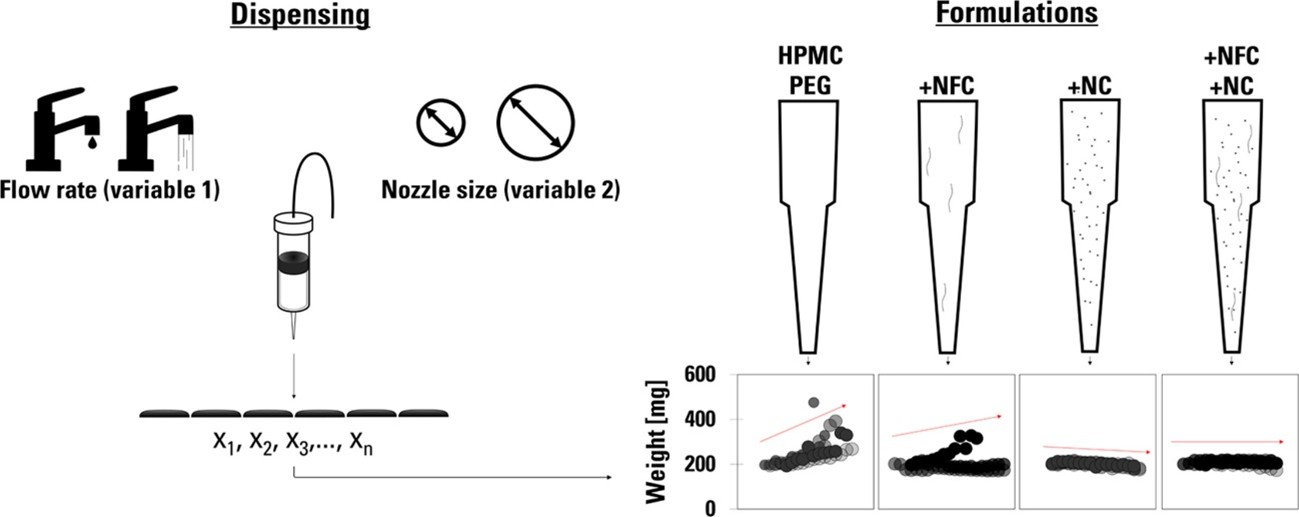
Drug nanocrystals is an attractive formulation strategy for improving the bioavailability of poorly water-soluble drugs. However, because nanocrystals remain suspended in the semisolid extrusion 3D printing formulation, dispensing of the material might be adversely affected by these particles. Dispensing precision was evaluated by analysing the weight variation during semisolid extrusion 3D printing. The formulation base, where itraconazole nanocrystals and nanofibrillated cellulose were added, consisted of polyethylene glycol, hydroxypropyl methylcellulose, and water. It was discovered that nanocrystals improved the dispensing precision compared to the nanocrystal free formulation base. Additionally, nanofibrillated cellulose could be combined with nanocrystals to improve the dispensing precision even further.