Bahman, J. Zini, J. Lahtinen, N. Hassinen, S. Verma, T. Laaksonen, S. Airaksinen, N. Sandler Topelius, T. Viitala
[ Pharm. Res. 2025, ; https://doi.org/10.1007/s11095-025-03911-6 ]
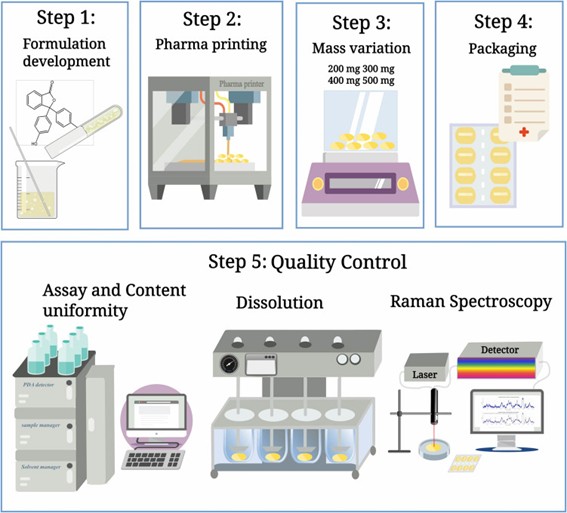
An automated SSE based Compounding System Solution (CSS) technology was assessed for creating customized Ondansetron tablets. Additionally, a non-destructive quality control method for the customized Ondansetron tablets was developed by utilizing Raman Spectroscopy (RS) measurements and partial least square (PLS) analysis. The mass uniformity tests showed high accuracy: 99.2% for varying drug content and 98.8% for different tablet sizes. All tablets met the acceptance criteria (AV < 15) and remained stable for six months at 25 ± 2 °C and ambient humidity. In-vitro dissolution tests confirmed over 85% drug release within 30 min, complying with USP standards. The RS-based PLS model predicted active pharmaceutical ingredient (API) content with a slope of 0.944 and an error of ~ 8%, which improved to 2-3% when excluding highly variable 10 mg samples. The model showed strong correlation with HPLC results and prediction (R2CV = 0.95, RMSECV = 0.68; R2Pred = 0.96, RMSEP = 0.57), using three latent variables.