Louis Bouckaert, Alexander De Man, Lisa De Souter, Fabian Starsich, Bernhard Meir, Sebastian Sowinski, Chris Vervaet, Thomas De Beer, Valérie Vanhoorne
[ Int. J. Pharm. 2025, 681:125622; https://doi.org/10.1016/j.ijpharm.2025.125622 ]
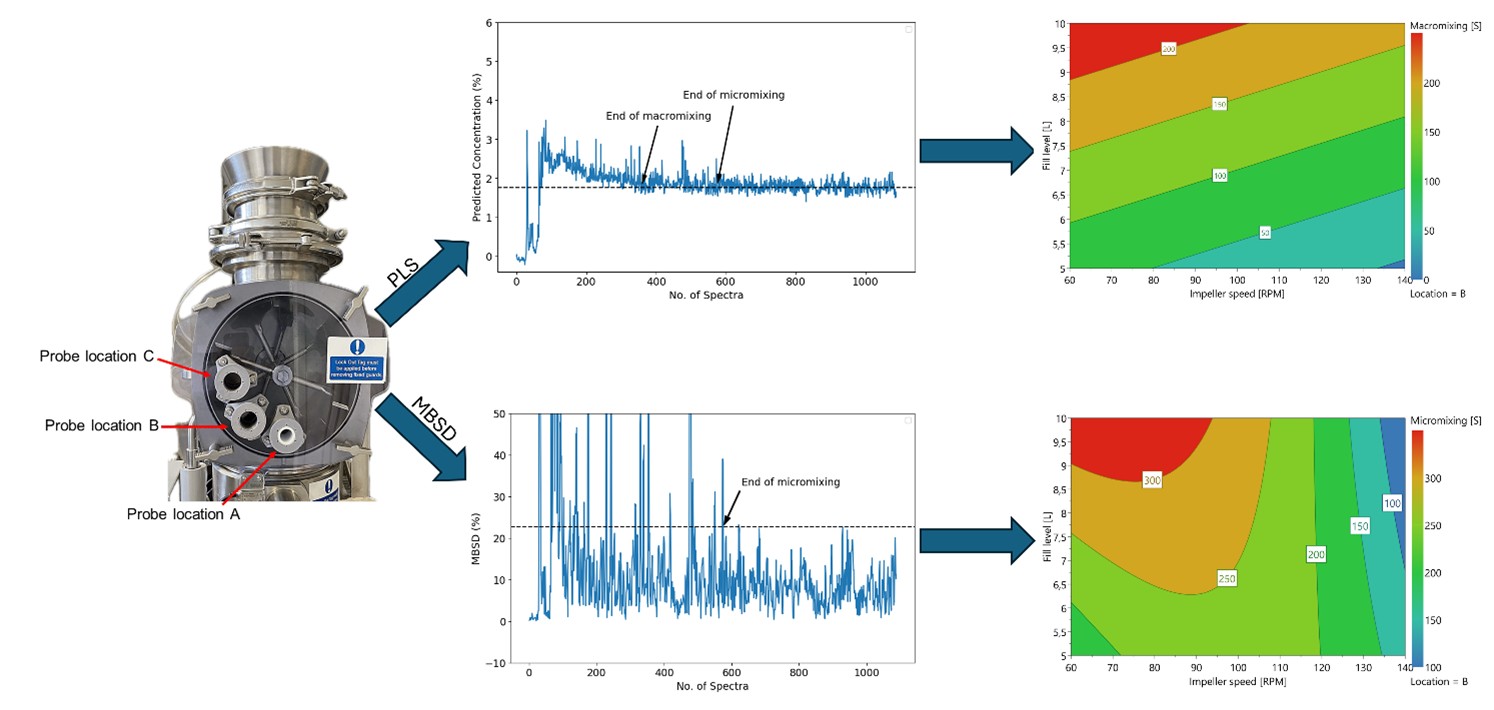
In continuous manufacturing, Process Analytical Technology (PAT) tools are part of the control strategy to ensure the intended quality of an intermediate or final product. The study investigates the implementation of in-line Near-Infrared (NIR) spectroscopy into a semi-continuous blending process, aiming to detect blend uniformity (2% caffeine) across varying process conditions. Two spectral analysis methods, including Partial Least Square (PLS) regression and the Moving Block Standard Deviation (MBSD) method were applied as endpoint detection procedures. These approaches enabled the assessment of both convective and dispersive mixing performance across the different blender settings.