H Cornelis, E Derveaux, A Singh, M Smet, P Adriaensens, G van den Mooter
Molecular Pharmaceutics, 2024, 21(11):5529 – 5538
https://doi.org/10.1021/acs.molpharmaceut.4c00472
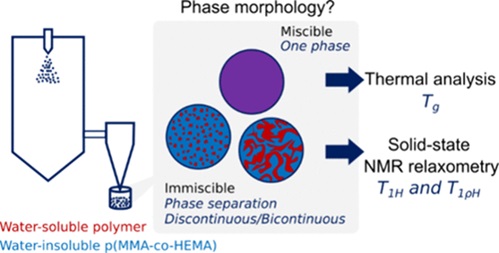
Ternary amorphous solid dispersions (ASDs) consist of a multicomponent carrier with the aim of improving physical stability or dissolution performance. A polymer blend as a carrier that combines a water-insoluble and a water-soluble polymer may delay the drug release rate, minimizing the risk of precipitation from the supersaturated state. Different microstructures of the ternary ASD may result in different drug release performances; hence, understanding the phase morphology of the polymer blend is crucial prior to drug incorporation.
The objective of this study is to investigate the miscibility of the water-insoluble p(MMA-co-HEMA) and water-soluble polymers such as HPC, HPMC, HPMC-AS, and Soluplus. To prepare the polymer blends, p(MMA-co-HEMA) was spray dried in 80/20 and 90/10 (w/w) ratios with one of the water-soluble polymers. Thermal analysis (mDSC and DMA) and solid-state (ss)NMR relaxometry were applied to study the miscibility of these blends.
No conclusions regarding miscibility could be drawn from the Tg measurements by thermal analysis. However, phase-separation could be demonstrated in all blends by ssNMR relaxometry. Moreover, by measuring both the T1ρH and T1H relaxation times, domain sizes between 5 and 50 nm could be estimated.